Heavy-duty cutting boards for serious home cooks need to survive daily high-volume chopping, resist warping from constant washing, and hold their surface integrity for years, and titanium is the material that consistently delivers on all three where wood, bamboo, and plastic eventually fall short. I’ve put a titanium board through more than a year of nightly meal-prep, weekend batch cooking, and the occasional Thanksgiving marathon, and it still looks and performs close to how it did on day one. That’s not something I can say about the plastic board it replaced.
“Heavy-duty” gets used loosely in cutting board marketing, so let’s define it properly and then look at how the materials people actually consider stack up under real, repeated home use.
What “Heavy-Duty” Actually Means for a Home Cook
A board that’s heavy-duty for a serious home cook someone cooking most nights, batch prepping on weekends, breaking down whole chickens, or prepping large volumes of vegetables needs to hold up to a workload closer to light commercial use than casual cooking. That means:
- Resisting deep knife grooves over months, not weeks, since grooves are where bacteria and food residue accumulate even after washing.
- Handling frequent washing, including dishwasher or sanitize cycles, without warping, cracking, or delaminating.
- Staying flat and rigid under repeated use, rather than developing the slight bowing or cupping that thinner or lower-quality wood boards often show after a year of daily wash cycles.
- Tolerating heavier kitchen tasks, breaking down proteins, working with a cleaver, prepping dense vegetables without the surface degrading faster than it would under lighter use.
Thickness alone doesn’t make a board heavy-duty. A thick wood board can still warp and groove under serious daily use; what actually determines durability is the material’s hardness and how it responds to moisture and knife contact over time.
How the Common Materials Hold Up Under Serious Daily Use
Titanium
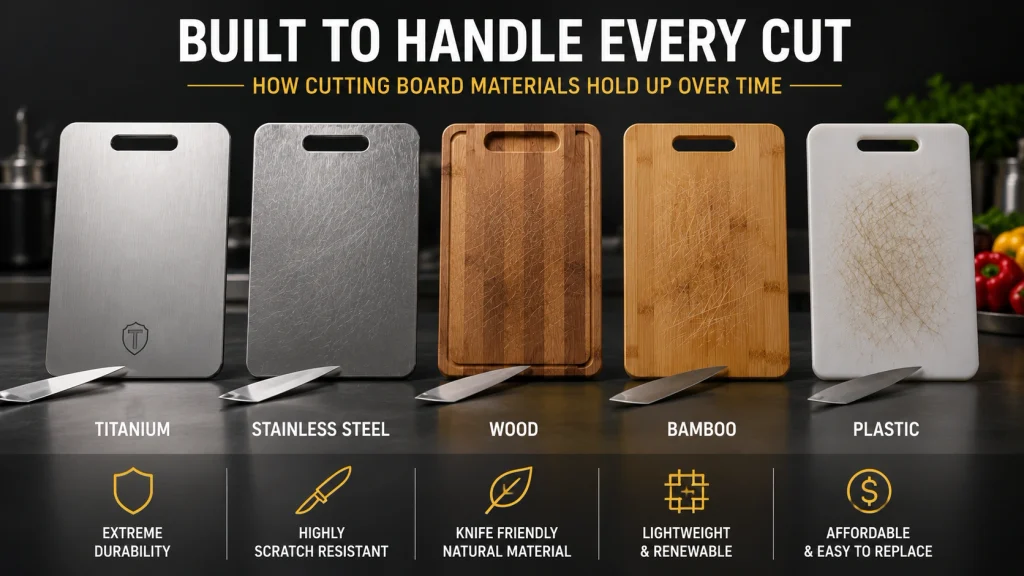
Titanium is harder than most standard kitchen knife steel, which is the core reason it resists the grooving that heavy daily cutting causes in softer materials. In practice, after a year of near-daily use, my titanium board shows light surface marks but nothing resembling the visible channels a plastic board develops in the same timeframe. It’s also fully non-porous, so repeated washing and even dishwasher sanitizing cycles don’t degrade it the way they would a wood board.
The trade-off worth being upfront about: titanium’s hardness means it’s tougher on knife edges than a softer surface. For a home cook using their board nightly, that typically translates to honing your knife slightly more often a few strokes every week or two- not a major maintenance burden, but a real one.
Stainless Steel
Stainless steel holds up well under heavy use and, like titanium, is non-porous and dishwasher-safe in most cases. It’s softer than titanium, though, so under serious daily volume it tends to show scratching sooner. For most home cooks, this stays cosmetic rather than functional for a good while, but it won’t match titanium’s long-term scratch resistance under identical use.
Wood
A dense hardwood board (like maple or walnut) is a reasonable heavy-duty choice for cooks who prefer a traditional surface, but it comes with real maintenance overhead: regular oiling to prevent drying and cracking, hand-washing only, and periodic sanding to manage the grooves that build up from daily knife contact. Skip the oiling routine for a few months under heavy use, and a wood board’s lifespan drops noticeably. This is the maintenance mistake I see most often with people who buy a nice wood board and then treat it like a low-maintenance surface.
Bamboo
Bamboo markets itself as durable, but it’s more brittle than true hardwood because it’s a grass, not a hardwood. Under heavy daily cutting volume, bamboo tends to splinter along its grain sooner than dense hardwood, particularly at board edges and corners that take repeated impact.
Plastic
Plastic is the least heavy-duty option in this comparison. It’s the softest common material, so it scores fast under serious daily cutting, developing visible grooves within weeks under high-volume use. It’s a fine choice for lighter cooking, but for someone cooking nightly and prepping in volume, plastic boards typically need replacing far more often than any of the alternatives above.
The Misconception Most Buyers Have About “Durable” Materials
Here’s the point of view that surface-level buying guides usually miss: durability and knife-friendliness are not the same thing, and a board being “hard on knives” doesn’t mean it’s poorly made; it usually means the opposite. A board’s hardness relative to your knife steel is the entire mechanism behind scratch resistance. If a board feels “gentle” on your knife, it’s because the board itself is absorbing the wear that would otherwise deflect off a harder surface. For someone specifically shopping for heavy-duty durability, that gentleness is actually a sign the board will wear out faster, not a bonus feature.
A Practical Buying Checklist for Heavy-Duty Cutting Boards
- Match the material to your actual cooking frequency. Someone cooking nightly benefits far more from titanium or hardened stainless than someone cooking a few times a week.
- Check thickness in combination with material, not alone; a thin titanium board can outperform a thick, softer board in rigidity and wear resistance.
- Confirm dishwasher or sanitize-cycle compatibility if you wash boards frequently, since not every “durable” material tolerates repeated high-heat cycles.
- Plan for knife maintenance if you choose a harder material. Budget a regular honing routine into your kitchen habits rather than treating it as an afterthought.
- Consider board size relative to your prep volume. A larger surface reduces how much repeated cutting concentrates in one area, which can extend the visible lifespan of any material.
- If choosing wood, commit to the maintenance routine of regular oiling and hand-washing, or expect a shorter usable lifespan than the material is capable of.
FAQ
Titanium is generally the most durable option for serious daily use, resisting the deep knife grooves that develop in wood, bamboo, and plastic under equivalent cutting volume, thanks to its hardness relative to standard kitchen knife steel.
In most cases, yes, if the board’s durability comes from hardness (as with titanium or hardened stainless steel). Expect to hone or sharpen your knives somewhat more frequently in exchange for a board that lasts significantly longer.
Not necessarily. Thickness helps with rigidity, but material hardness is what actually determines resistance to knife grooving and long-term wear. A thin, hard board can outperform a thick, soft one under serious daily use.
Based on typical use, a titanium or hardened stainless board can maintain its surface integrity for several years of near-daily cooking, while wood requires consistent maintenance to reach a similar lifespan, and plastic generally needs replacing much sooner under equivalent volume.
The Bottom Line
For serious home cooks who chop nightly and prep in real volume, titanium is the strongest heavy-duty cutting board material available, holding its surface far longer than wood, bamboo, or plastic under equivalent daily use. The trade-off is a modestly more frequent knife-honing routine a small, predictable cost for a board built to handle serious kitchen work for years, not months.
Browse our full range of heavy-duty titanium cutting boards at titanium cutting board and find the size that fits your kitchen’s workload.