The best commercial cutting boards for high-volume kitchens are non-porous, scratch-resistant, and built to survive constant sanitizing without warping or grooving, which is why titanium and hardened stainless steel outperform the color-coded plastic boards most commercial kitchens default to. I’ve consulted with a few small restaurant operators on kitchen equipment decisions, and the pattern is consistent: plastic boards get replaced every few months under real commercial volume, while a well-maintained titanium board holds its surface integrity for years under the same workload.
That said, “commercial-grade” gets thrown around loosely in cutting board marketing. Here’s what it actually needs to mean if you’re cutting hundreds of times a day, running boards through sanitize cycles constantly, and can’t afford downtime for equipment that fails early.

What “Commercial-Grade” Should Actually Mean
A lot of boards marketed as commercial-grade are really just thicker versions of home boards. Thickness alone doesn’t determine whether a board survives commercial use. What actually matters:
- Surface hardness relative to constant knife contact. A board that’s cut on hundreds of times a day needs to resist grooving far faster than a home board would, or it becomes a hygiene liability within weeks, not months.
- Sanitize-cycle tolerance. Commercial kitchens run boards through high-heat sanitizing constantly, often daily, sometimes multiple times a shift. A material that warps, cracks, or degrades under repeated high-temperature exposure isn’t viable at commercial volume, even if it performs fine at home.
- Non-porous construction. Health code inspections specifically look at whether a cutting surface can trap bacteria in grooves or pores. This is where wood is disqualified from most commercial settings outright, and where heavily scored plastic starts failing inspection even though it passed when new.
- Consistent surface across heavy daily use, not just out-of-the-box performance. A board that looks fine in a product photo but scores deeply after two weeks of prep-line volume isn’t commercial-grade, regardless of what the label says.
How the Common Materials Actually Hold Up at Commercial Volume
Titanium
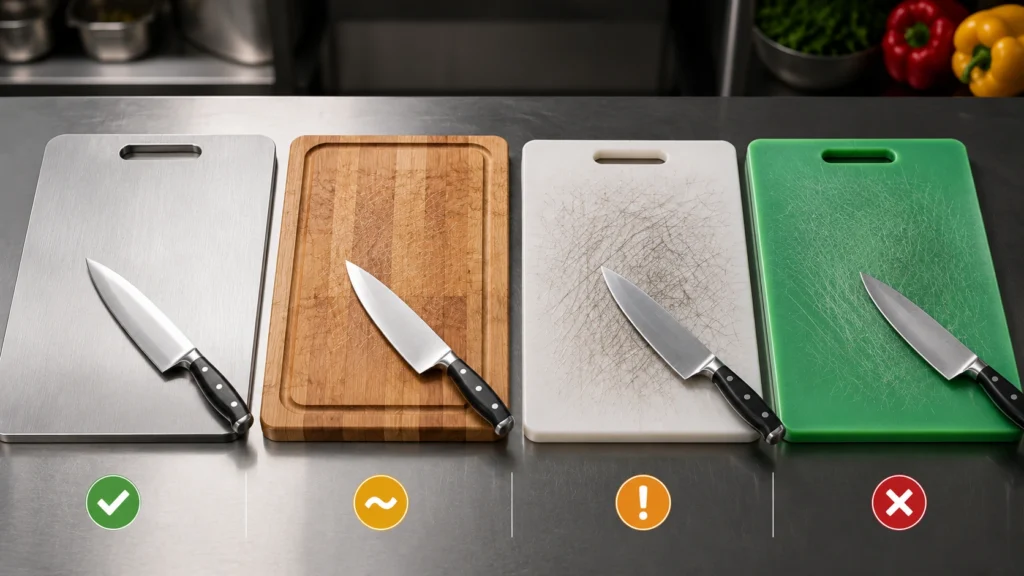
Titanium is harder than most standard kitchen knife steel, which is the core reason it resists the deep grooving that commercial-volume cutting causes in softer materials. In practice, a titanium board under heavy daily use develops light surface marks but not the visible channels that trap food residue, which is exactly the kind of wear pattern a health inspector wants to see. It’s also fully non-porous and tolerates dishwasher and sanitize-cycle heat that would warp wood or degrade some plastics over time.
The honest trade-off: titanium’s hardness is tougher on knife edges than plastic, so kitchens running titanium boards should expect to sharpen or hone knives more frequently. For a prep station doing high knife-hour volume, that’s a real maintenance line item, not a footnote — budget for it.
Stainless Steel
Stainless steel is a common choice in professional kitchens for good reason: it’s non-porous, sanitizes well, and handles heat. It’s softer than titanium, though, so it scratches sooner under equivalent volume. In most cases, this scratching stays cosmetic rather than functional for the first year or two, but it will eventually need replacement sooner than a titanium board under identical use.
Color-Coded Plastic (HACCP Boards)
Plastic HACCP boards (the color-coded system separating raw meat, produce, seafood, etc.) are the commercial kitchen standard for a reason they’re cheap, lightweight, and the color system reduces cross-contamination risk regardless of material hardness. But plastic scores fast under commercial cutting volume. Most health-code guidance already assumes plastic boards need periodic replacement once visible grooving develops, which in a busy kitchen can mean every few months, not years.
Wood
Wood is largely excluded from commercial kitchen use in most jurisdictions specifically because it’s porous and can’t reliably pass sanitizing requirements at the volume and speed commercial operations demand. Even where it’s technically permitted, most health inspectors flag wood boards showing visible scarring, which happens fast under commercial cutting frequency.
The Trade-Off Most Commercial Buyers Miss
Here’s the insight that gets skipped in most “best commercial cutting board” roundups: the total cost of a cutting board isn’t the purchase price; it’s the purchase price plus the replacement frequency plus the knife maintenance it drives. A cheap plastic board that needs replacing every few months at commercial volume can cost more over two years than a single titanium board that needs slightly more frequent knife sharpening but doesn’t need replacing at all.
For a kitchen doing high daily cutting volume, that math usually favors a harder, longer-lasting surface assuming the kitchen already has (or is willing to build) a consistent knife maintenance routine. For a lower-volume operation without dedicated sharpening habits, plastic’s lower knife-wear cost may still make more sense.
A Practical Framework for Choosing a Commercial-Grade Board
- Match the board to your actual cutting volume, not your kitchen’s size. A high-turnover prep station benefits far more from a scratch-resistant surface than a low-volume garnish station.
- Confirm sanitize-cycle compatibility with your dish machine’s actual temperature settings, not just a general “dishwasher safe” label.
- Check your local health code requirements for cutting surface materials before purchasing wood restrictions vary by jurisdiction.
- Budget for knife maintenance alongside the board itself if you’re choosing a harder material like titanium or stainless.
- Consider a mixed setup: a durable primary board for high-volume stations, with lighter boards for lower-frequency tasks.
- Weigh total cost of ownership over 12–24 months, not just sticker price, when comparing materials.
FAQ
Color-coded plastic (HACCP) boards remain the most common due to low cost and cross-contamination color-coding, though titanium and stainless steel are increasingly used at prep stations with high cutting volume where durability matters more than upfront cost.
It depends on local health code, but wood is restricted or excluded in many jurisdictions because its porous surface can’t reliably meet commercial sanitizing standards. Check your local regulations before relying on wood boards commercially.
Yes, in most cases, titanium’s hardness means more frequent honing or sharpening compared to plastic. For kitchens with a consistent knife maintenance routine, this is a manageable trade-off for a board that lasts significantly longer.
Plastic boards typically need replacement once visible grooving develops, which under high commercial volume can happen within months. Non-porous metal boards like titanium generally hold their surface integrity far longer under equivalent use.
The Bottom Line
The best commercial cutting boards aren’t necessarily the cheapest or the thickest they’re the ones that survive real daily volume without developing the grooves that fail health inspections and compromise food safety. Titanium offers the strongest long-term durability of any commonly available material, at the cost of slightly more frequent knife maintenance, making it worth serious consideration for any kitchen doing high-volume daily prep.
Explore our commercial-grade titanium cutting boards in the Titanium Cutting Board Buying Guide and find the right size and thickness for your kitchen’s volume.