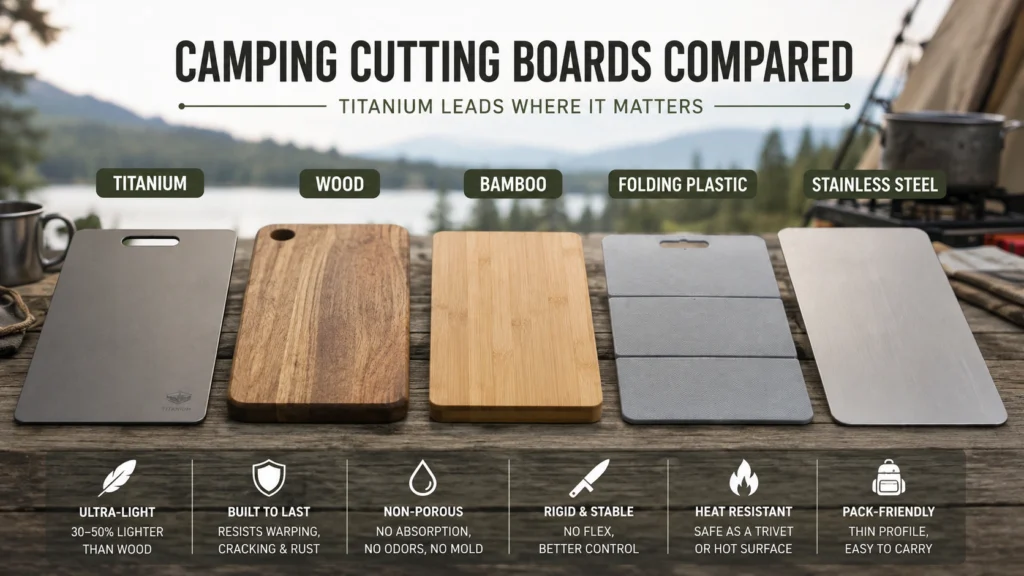
The best ultra-light cutting board for camping is a titanium board, not the folding plastic mats or bamboo boards most campers default to. Titanium cutting boards typically weigh 30-50% less than an equivalent-size wood board, resist warping in humid or hot storage conditions, and survive being crammed into a pack or RV drawer for months without cracking. After outfitting my own truck-camping kitchen kit and testing several materials across three camping seasons, titanium is the only board I haven’t had to replace.
Weight isn’t the only thing that matters when you’re deciding what goes in a camp kitchen box, though. Let’s go through what actually holds up on the road, what doesn’t, and how to pick a board that earns its spot in your pack.

Why Weight Alone Isn’t the Right Metric
Most “lightest cutting board” articles rank boards purely by grams, which misses the point for campers and RV owners. A board that’s light but flexes, warps, or absorbs moisture ends up being dead weight the second it fails on trip three.
Here’s what I actually weigh boards against for travel use:
- Weight-to-durability ratio: not just how light it is out of the box, but how it holds up after repeated packing, unpacking, and temperature swings.
- Moisture tolerance: RVs and tents trap humidity. A board that swells or grows mold in a sealed bin is a liability, not a convenience.
- Rigidity under a knife stroke: a too-thin, too-light board flexes mid-cut, which is both annoying and a knife-control safety issue when you’re prepping food on an unstable camp table.
- Pack footprint thickness and shape matter as much as weight when you’re optimizing a 40-liter pack or a small RV galley drawer.
Titanium performs well on all four because it’s a rigid metal that doesn’t need thickness to stay stiff. A titanium board can be milled thin (often 2- 3 mm) without losing the rigidity a thicker wood or plastic board needs to avoid flexing.
How Titanium Compares to Other Lightweight Camping Board Materials
Titanium vs. Wood
Wood cutting boards feel premium at home, but they’re a poor travel choice. Wood absorbs moisture from humid air, tent condensation, or a poorly sealed cooler, and that absorption is what causes warping, cracking, and eventually mold problems that show up specifically in the swing-humidity conditions of camping, not necessarily in a climate-controlled kitchen. Titanium is non-porous, so it doesn’t care how humid your last three campsites were.
Titanium vs. Bamboo
Bamboo is marketed as the “eco lightweight” option, and it is lighter than hardwood. But bamboo is a grass, not a hardwood, and it’s more prone to splintering along the grain after repeated wet-dry cycles, exactly what camping puts it through. I’ve had a bamboo board delaminate at the edges after one particularly damp week at a coastal site. Titanium has no grain to split.
Titanium vs. Folding Plastic Cutting Mats
Folding plastic mats are the lightest option by weight, and for ultralight backpacking where every gram counts, they still have a place. But they score bacteria and food residue into knife grooves fast; they don’t offer a stable cutting surface on uneven camp tables, and most degrade under repeated sun exposure. If you’re weight-obsessed to the gram and only need to slice a few things, a plastic mat is fine. If you actually cook at camp vegetables, meat, cheese, bread a titanium board gives you a stable, cleanable surface at a comparable weight to a rigid plastic board, without the grooves.
Titanium vs. Other Metals (Stainless Steel, Aluminum)
Stainless steel is more corrosion-resistant than most metals but is noticeably heavier than titanium at equivalent thickness, which matters when every ounce in a pack counts. Aluminum is lighter than stainless but softer, meaning it dents and scratches more easily under repeated knife use, and some aluminum alloys can react with acidic foods like citrus or tomatoes, leaving a metallic taste. Titanium sits in the sweet spot: close to aluminum’s weight, closer to stainless’s durability, and chemically inert against acidic camp-cooking staples.
Does a Titanium Board Dull Your Knives Faster in the Field?
This is the most common hesitation I hear from campers switching to metal boards, so it’s worth addressing directly: yes, titanium is a harder surface than wood or plastic, and in most cases you’ll need to touch up your knife edge slightly more often than you would with a wood board at home. In practice, for camp cooking where you’re typically doing rough chopping and prep rather than fine knife work, this trade-off is minor. Bring a small pocket sharpener or a folding ceramic hone if you’re on a multi-week trip; a few strokes every week or two keeps most knives camp-ready on a titanium surface.
A Practical Checklist for Choosing a Camping Cutting Board
Use this framework when comparing boards, whether you’re buying titanium or something else:
- Check the thickness-to-weight spec, not just total weight. A 3mm titanium board that doesn’t flex beats a thicker plastic board that does.
- Confirm it’s genuinely packable, with rounded corners, a carry loop, or a slim profile that fits your specific pack or drawer.
- Look for a non-porous, sealed surface if you’re avoiding wood or bamboo, since moisture resistance matters more on the road than at home.
- Verify it’s dishwasher- or easy-rinse-safe, since camp cleanup usually means a splash of water, not a full scrub.
- Consider dual-use potential: a titanium board doubles as a heat-safe surface for a hot pan off the stove, which a plastic board can’t do.
- Match the size to your actual cooking style, not the biggest board available. A 10×7-inch board handles most two-person camp meals without eating pack space.
FAQ
What’s the lightest material for a camping cutting board?
Folding plastic mats are typically the lightest by raw weight, but titanium boards offer the best balance of low weight and real durability for anyone doing actual food prep at camp, not just quick slicing.
Is a titanium cutting board worth it for RV kitchens specifically?
Yes, in most cases. RV galleys deal with constant motion, temperature swings, and limited storage, and a titanium board’s rigidity and moisture resistance hold up better than wood or bamboo under those conditions over a full camping season.
Will a titanium board scratch my knives or affect my knife edge?
Titanium is harder than wood or plastic, so you’ll likely sharpen slightly more often. It won’t damage a knife’s edge outright, but expect more frequent light touch-ups compared to using a softer cutting surface.
Can I use a titanium cutting board directly on a camp stove or hot surface?
Titanium tolerates heat far better than wood, bamboo, or plastic, making it reasonable as a trivet or hot-pan landing spot in a pinch, though it’s still worth checking your specific board’s manufacturer guidance before treating it as a dedicated heat surface.
The Bottom Line
If you’re outfitting a camp kitchen or RV galley and want a board that survives more than one season, titanium beats wood, bamboo, and plastic on the combination that actually matters for travel: low weight, real rigidity, and moisture resistance that doesn’t care about tent condensation or humid coastal campsites. It’s a small trade-off in sharpening frequency for a board you won’t be replacing after your next trip.
Ready to upgrade your camp kitchen? Browse our full lineup of ultra-light titanium cutting boards at titaniumcuttingsboard.com and find the size that fits your pack, your galley, and your next trip.