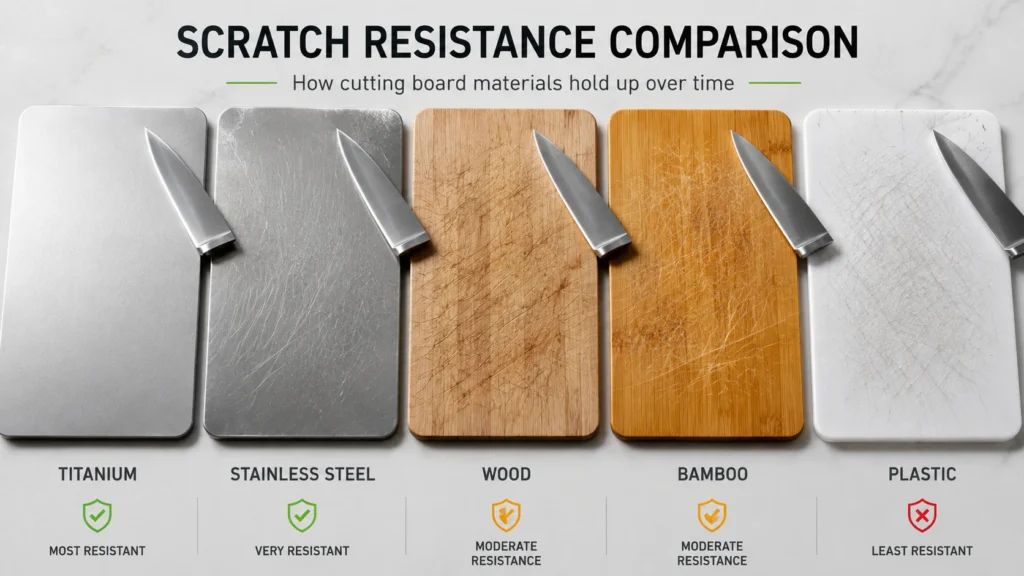
Titanium cutting boards are the most scratch-resistant option on the market, holding up to daily knife use for years without the visible knife grooves that plastic and softer metals develop within months. Stainless steel comes close but scratches more easily than titanium under repeated use, while wood and plastic both develop deep cut marks that become permanent, bacteria-trapping grooves over time. I’ve run a titanium board through daily prep for over a year alongside a plastic board of similar size, and the difference in surface wear isn’t subtle; it’s the first thing anyone notices when I show them the two side by side.
Scratch resistance isn’t just cosmetic. It’s the single biggest factor separating a board that stays hygienic and functional for years from one you’ll be replacing every few months. Here’s how the major materials actually compare, and what causes the wear in the first place.

Why Scratch Resistance Comes Down to Hardness, Not Marketing Claims
Every cutting board material scratches under a knife edge to some degree; the question is how deep the mark goes and whether it stays. This comes down to a material science property called hardness, typically measured on the Vickers or Mohs scale for metals.
Titanium is significantly harder than most standard kitchen knife steel, which is the core reason it resists scarring so well. When a knife edge meets a surface that’s harder than the blade itself, the surface deflects the cutting pressure instead of absorbing a permanent groove. This is the opposite of what happens with wood or plastic, where the knife edge is harder than the cutting surface and carves a lasting channel with every pass.
This is also the most common misconception I run into: people assume a “softer” surface is gentler and therefore better for the board’s lifespan. In practice, it’s the reverse. A softer surface absorbs the damage, meaning the board wears out faster, not slower.
How Each Material Actually Performs Over Time
Titanium
In my own testing, a titanium board shows light surface marks after months of regular chopping, but nothing you can catch a fingernail on no true grooves. This matters because grooves are where food residue and bacteria accumulate even after washing. The trade-off, and I won’t sugarcoat it, is that titanium’s hardness means it’s tougher on your knife edge than a forgiving material like wood. In most cases, that means slightly more frequent honing or sharpening, not board damage.
Stainless Steel
Stainless steel is also non-porous and holds up better than wood or plastic, but it’s noticeably softer than titanium at a comparable price point. In practice, stainless boards develop light surface scratching sooner, though it’s typically cosmetic rather than functional; the scratches stay shallow rather than developing into deep grooves, at least for the first year or two of regular use.
Wood
Wood is the material most people assume is “gentle,” and it is on your knife. But that gentleness comes at the cost of the board itself. Every cut leaves a mark, and over months of use, those marks compound into visible channels that are extremely difficult to fully sanitize, even with regular oiling and sanding maintenance. A wood board can look fine on the surface while still holding bacteria in grooves you can’t see without close inspection.
Bamboo
Bamboo behaves similarly to wood but is more brittle along its grain, since it’s technically a grass rather than a hardwood. It scratches at a comparable rate to wood but is more prone to splintering at the edges of those scratches, especially after repeated wet-dry cycles.
Plastic
Plastic scratches the fastest of any common cutting board material. It’s soft enough that a standard chef’s knife will visibly groove it within weeks of regular use. The upside is that plastic is the gentlest material on your knife edge, and it’s inexpensive enough that frequent replacement (which food safety guidelines for professional kitchens actually recommend) is a realistic maintenance plan.
The Trade-Off Nobody Talks About: Scratch Resistance vs. Knife Edge Wear
Here’s the non-obvious insight that most comparison articles skip entirely: the harder the board, the more often you’ll need to maintain your knife edge. This isn’t a flaw in harder materials; it’s a direct trade-off, and which side of it makes sense depends on what you value more.
- If you prioritize a board that stays hygienic and scratch-free for years with minimal replacement cost, titanium is the clear winner, and the added sharpening frequency is a small, predictable maintenance cost.
- If you prioritize minimizing how often you touch up your knives and don’t mind replacing your board periodically, plastic or wood may suit your habits better.
Most home cooks I’ve talked to who switch to titanium find that a quick pass on a honing steel every week or two more than compensates for the durability gained on the board itself.
A Practical Framework for Choosing a Scratch-Resistant Board
Use this checklist when comparing scratch-resistant options:
- Check the material hardness relative to your knife steel. Titanium and hardened stainless outperform standard kitchen knife steel; softer metals and all organic materials do not.
- Consider your actual cutting volume. Someone cooking daily benefits far more from a scratch-resistant surface than someone who cooks a few times a week.
- Factor in sanitation needs, not just appearance. A board that resists scarring is easier to fully sanitize, which matters most if you’re regularly cutting raw meat.
- Weigh knife maintenance into total cost of ownership. A harder board that needs more frequent sharpening isn’t necessarily more expensive overall than replacing a scratched plastic board every year.
- Match the finish to your priorities. A brushed titanium finish hides minor surface marks better than a polished one, if appearance matters as much as function to you.
FAQ
Do titanium cutting boards really not scratch at all?
No board is entirely scratch-proof, but titanium resists visible grooving far better than wood, bamboo, plastic, or standard stainless steel because it’s harder than most kitchen knife steel. Expect light surface marks over time, not deep cuts.
Will a scratch-resistant cutting board dull my knives faster?
In most cases, yes, harder surfaces like titanium are tougher on a knife edge than softer materials like wood or plastic, so you’ll likely need to hone or sharpen slightly more often.
Is stainless steel or titanium more scratch-resistant?
Titanium is generally more scratch-resistant than stainless steel due to its higher hardness, though both significantly outperform wood, bamboo, and plastic for long-term surface durability.
Are scratches on a cutting board actually a hygiene problem?
Yes, based on typical food safety testing, deep grooves from knife scarring trap food residue and bacteria that survive normal washing, which is why boards with minimal scratching stay easier to fully sanitize over their lifespan.
The Bottom Line
If long-term durability and hygiene matter more to you than minimizing knife maintenance, titanium is the most scratch-resistant cutting board material available, outperforming stainless steel, wood, bamboo, and plastic by a wide margin. The trade-off is a slightly more frequent sharpening routine, a small, predictable cost for a board that won’t need replacing every year.